Image Source: Shutterstock
More than ten months after federal clean vehicle tax credits expired, the U.S. electric vehicle (EV) market is showing signs of stabilization. Sales data from June 2026 is now live on EV Hub, giving us a full picture of the EV market in the first half of the year; EV sales have recovered from a multi-year low but remain below last year’s pace.
At the same time, the broader electrified vehicle market continues to grow despite declines in battery-electric (BEV) and plug-in hybrid electric vehicle (PHEV) sales. Combined market share for BEVs, PHEVs, and conventional hybrid electric vehicles (HEVs) reached 24 percent in Q2 2026, up from 22 percent in Q2 2025, suggesting that some consumers may be turning to more efficient vehicles as fuel prices rise. For policymakers and transportation electrification stakeholders, the shift raises an important question:
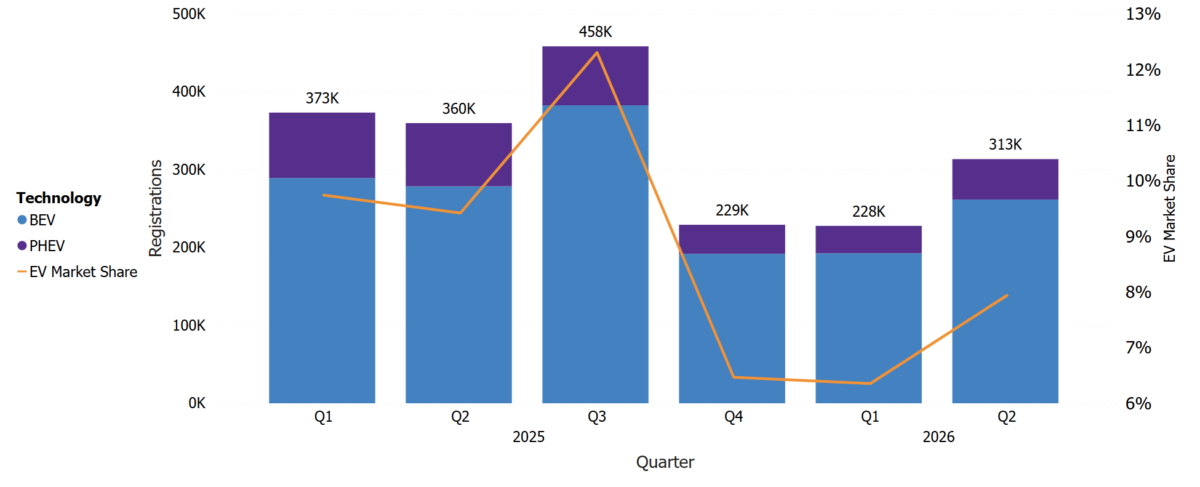
Figure 1: Quarterly U.S. Light-Duty EV Sales and Market Share (Q1 2025-Q2 2026)
Source: EV Hub EV Market Dashboard
Light-duty EV sales climbed in Q2 2026 following an uneven start to the year and a volatile end to 2025. As buyers rushed to claim federal tax credits before they expired at the end of Q3 2025, EV sales reached a record high before falling by nearly half in Q4, indicating that the deadline pulled some purchases forward (Figure 1). The slowdown continued into early 2026 with approximately 228,000 EVs sold during Q1, a 39 percent decline year-over-year.
As gasoline prices started to rise in March and remained high throughout Q2, the EV market began to recover. Light-duty EV sales role from approximately 62,000 vehicles in January 2026, to 110,000 in June 2026, the strongest month since the federal credits expired. However, the rebound in EV sales does not mean that plug-in vehicles are capturing a larger share of the overall market. Instead, recent growth in electrified vehicle adoption has been greater in the conventional hybrid market, suggesting that consumers’ interest in greater fuel efficiency does not translate evenly across electrified technologies.
According to the U.S. Energy and Information Agency, hybrid vehicles reached a record 16 percent of U.S. light-duty vehicle sales in Q2 2026. Over the same period, BEV market share slipped from 7 percent to 6 percent year-over-year, while PHEV share fell from 1.9 percent to 1.4 percent. the EV market, charging demand, and transportation electrification more broadly.
While conventional hybrids offer incremental fuel savings for consumers, they do not increase charging demand, build the case for infrastructure investment, or enable the zero-tailpipe-emission travel that plug-ins provide. Of the electrified vehicle technologies on the market, BEVs and PHEVs are better positioned to deliver deep, lasting reductions in transportation emissions—which is precisely why their recent softening warrants attention. With federal purchase credits no longer available, sustaining plug-in vehicle adoption may depend more heavily on state and utility programs, charging access, affordability, and the growing used EV market.
The second half of 2026 will reveal whether the market’s recovery in Q2 marks durable momentum or the beginning of a smaller, slower-growing U.S. EV market.