Most American drivers buy used vehicles. Cox Automotive estimates that 2.4 times as many used vehicles will be sold in 2026 than new vehicles (38.3 million used sales expected in 2026 and 15.8 million new sales expected in 2026). This makes the used electric vehicle (EV) market an important avenue for EV adoption. Over the last six years, the used EV market has evolved from a niche market segment into a realistic, affordable option for many Americans. As new vehicle prices continue to rise due to external market factors, used EVs are becoming an increasingly accessible option for households seeking lower-cost transportation, helping broaden access to EVs beyond early adopters and higher-income buyers. Affordability varies by vehicle type, charging access, financing terms, and household eligibility for incentives.
To produce this data story, we have explored the market and policy trends behind the burgeoning market’s growth. We found that the used EV market has grown more than four-fold (318 percent) over the last six years—with more than two million used EV registrations recorded over the period— and is expected to grow further.
We relied on Experian used vehicle registration data between 2020 and 2026 as a proxy for used EV sales. The data presented is akin to what is surfaced on our EV Hub’s EV Market Dashboard, but reflects used, rather than new EVs. The data reflects vehicles registered in each state and may not capture all private-party sales; accordingly, registration totals should be interpreted as indicators of broader market trends rather than a complete count of used EV transactions.
Used EV Market Growth Follows the New EV Market
While used EV registrations are still lower than new EV registrations, the market continues to grow steadily as EVs gain new vehicle market share and are eventually resold. This means that market trends for new EVs eventually impact the used EV market, although with a time delay depending on how long drivers own or lease new EVs. The used EV product catalog also continues to grow along with the new market, with about 140 more vehicle models available to consumers in Q1 2026 than in Q1 2020.
Previous Federal Policy Drove Growth
The Inflation Reduction Act’s (IRA’s) re-vamped electric vehicle tax credits were among the most consequential federal policies affecting both the new and used market in the last six years, introducing incentives for new vehicles, used vehicles, and commercial vehicles. The Previously Owned Clean Vehicle Credit applied an up to $4,000 tax rebate for a qualifying used EV. The IRA’s credit amounts for the new market were higher, offering up to $7,500 for both the Clean Vehicle Tax Credit and Commercial Clean Vehicle Tax Credit, which allowed businesses, including leasing companies, to purchase EVs.
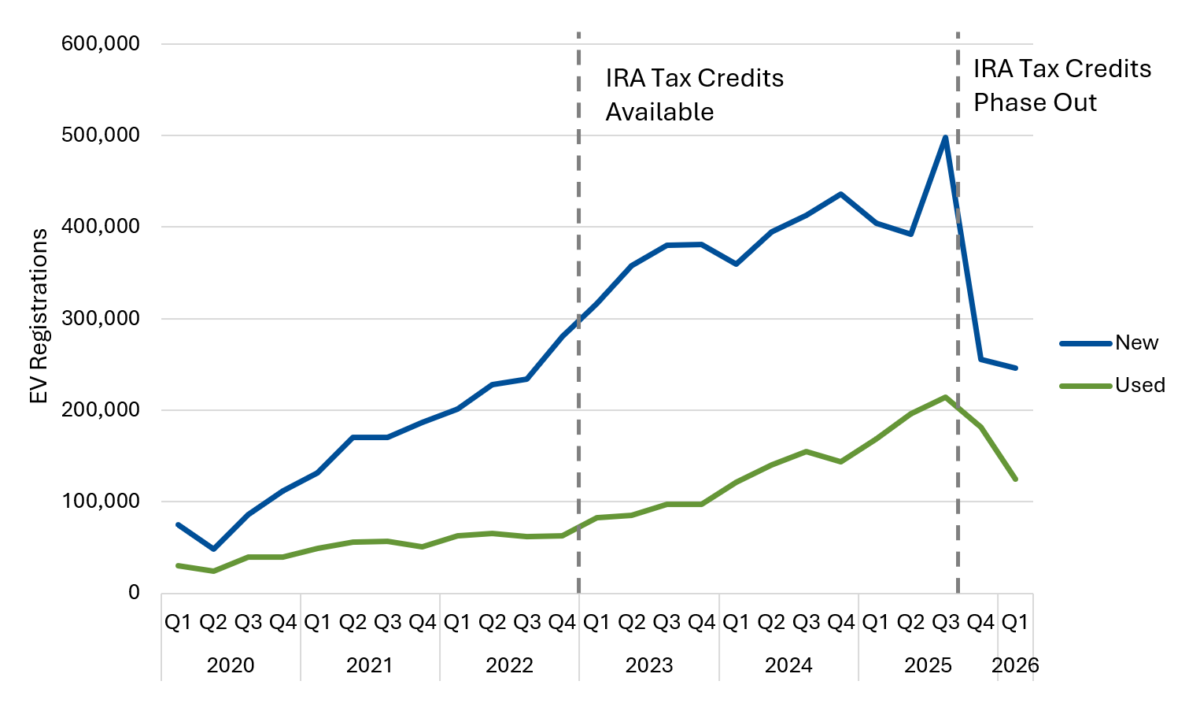
The credits became available in the 2023 tax year, and starting in 2024 buyers could transfer the credit to a participating dealer and receive the incentive at the point of sale. Eligibility for credits was subject to buyer income limits and retail price caps. As shown in Figure 1, new and used EV registrations increased following implementation of IRA credits. Average quarterly new registrations increased from 160,228 in 2020–2022 to 393,822 in 2023–2025 Q3 (146 percent) and average quarterly used registrations increased from 49,871 to 136,406 (174 percent). However, registration data alone cannot isolate the effect of tax credits from other market factors like improved technology or charger access.
In July 2025, Congress passed the One Big Beautiful Bill Act, which terminated the three vehicle credits for vehicles acquired after September 30, 2025, seven years earlier than the 2032 expiration date established under the IRA. This policy change created a deadline-driven increase in new EV purchases as buyers moved to claim the credits before they expired, followed by a sharp decline after the deadline.
Figure 1: Used and New Electric Vehicle Registrations from Q1 2020 to Q1 2026
Source: Experian new and used vehicle registrations.
Used EV registrations declined less sharply than new EV registrations immediately following the expiration of the IRA tax credits in Q3 2025. Between Q3 and Q4 2025, new EV registrations fell by approximately 49 percent, compared with a decline of about 15 percent in used EV registrations. This difference suggests that the immediate market response to the credits’ expiration was more pronounced for new EVs than for used EVs. However, additional quarters of data will be needed to assess the longer-term effects of policy change on both markets.
Changes in Technology and Vehicle Type
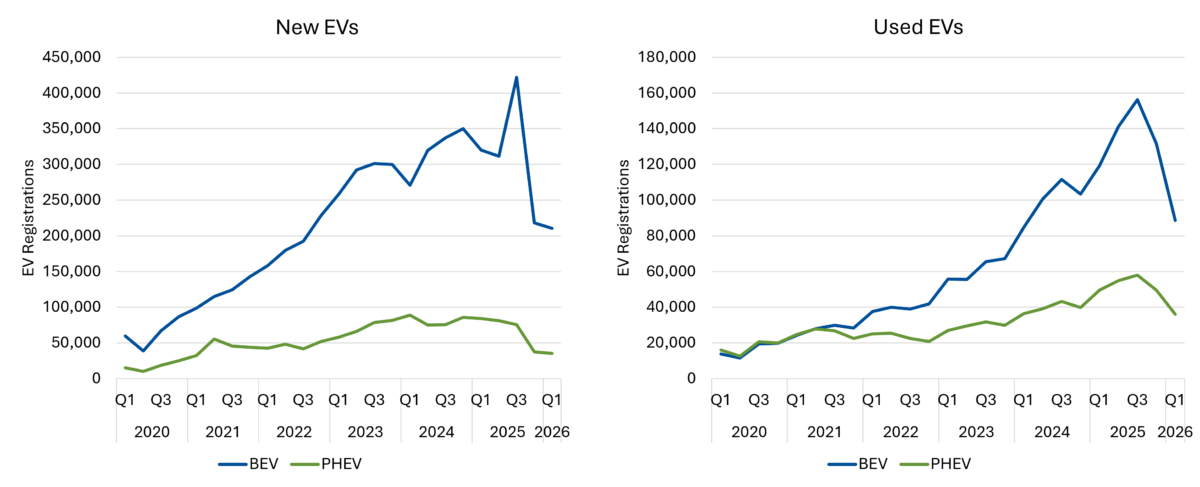
One example of the delayed impact of trends in the new market on the used market is the divergence between battery electric vehicle (BEV) and plug-in hybrid electric vehicle (PHEV) technology. In the new vehicle market, the last time PHEVs reached comparable registrations to BEVs was Q2 2017; the divergence between the two technologies appeared in the used market approximately five years later (Figure 2).
Figure 2: Comparison of BEV and PHEV Registrations for New and Used Markets from Q1 2020 to Q1 2026
Source: Experian new and used vehicle registrations.
Another similarity with the new EV market is the rapid growth in used electric sport utility vehicles (SUVs). The market share of SUVs—which includes both large SUVs and smaller crossovers—has grown by 37 percent since 2020, reflecting an automotive industry wide shift in production share of SUVs and larger body types. SUVs are strongly represented among the most popular EVs in the used market, with SUVs like the PHEV Jeep Wrangler, the Tesla Model Y, and the Model X, all among the ten most registered models in the market.
Figure 3: Percent of Used EV Registrations by Vehicle Type, 2020 and 2025
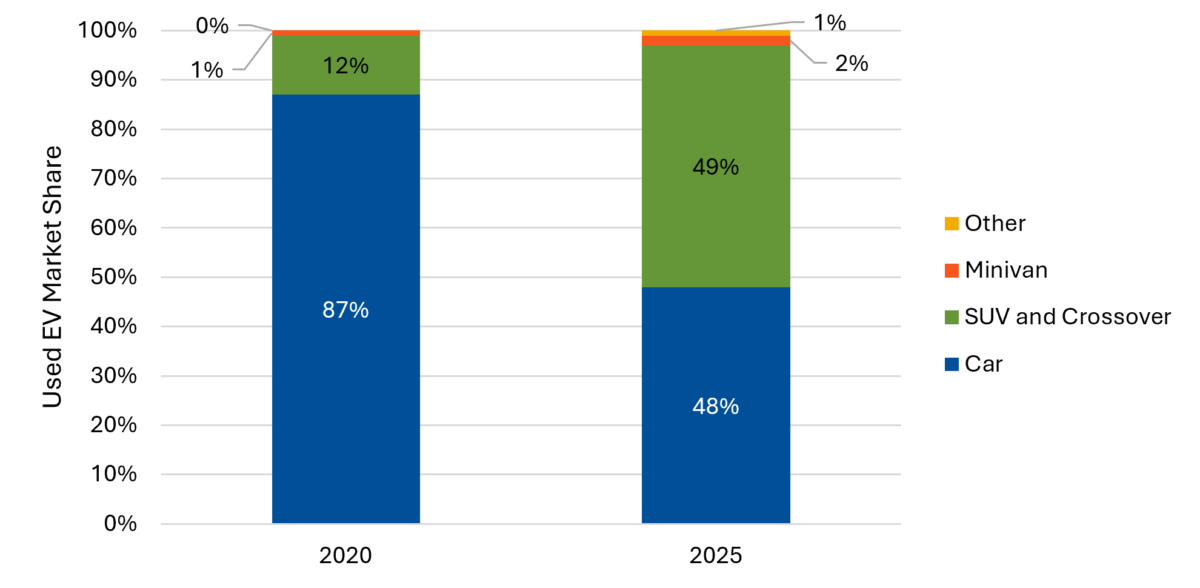
“Other” includes light- and medium-duty trucks, medium- and heavy-duty straight trucks, cargo and step vans, school buses, transit and coach buses, and tractors.
Source: Experian used vehicle registrations.
While the new and used markets are closely tied, one challenge in translating new EV sales into used EV growth is the relatively higher rate of depreciation in EVs compared to gas-powered vehicles. Technological advancements in the new EV market have helped ease this concern. For example, the average battery size increased 167 percent from 2014 to 2024 and battery replacements have become rarer in EV models produced after 2017. Federal law requiring an eight-year battery warranty has helped build consumer confidence in EV longevity.
State Progress in the Used EV Market
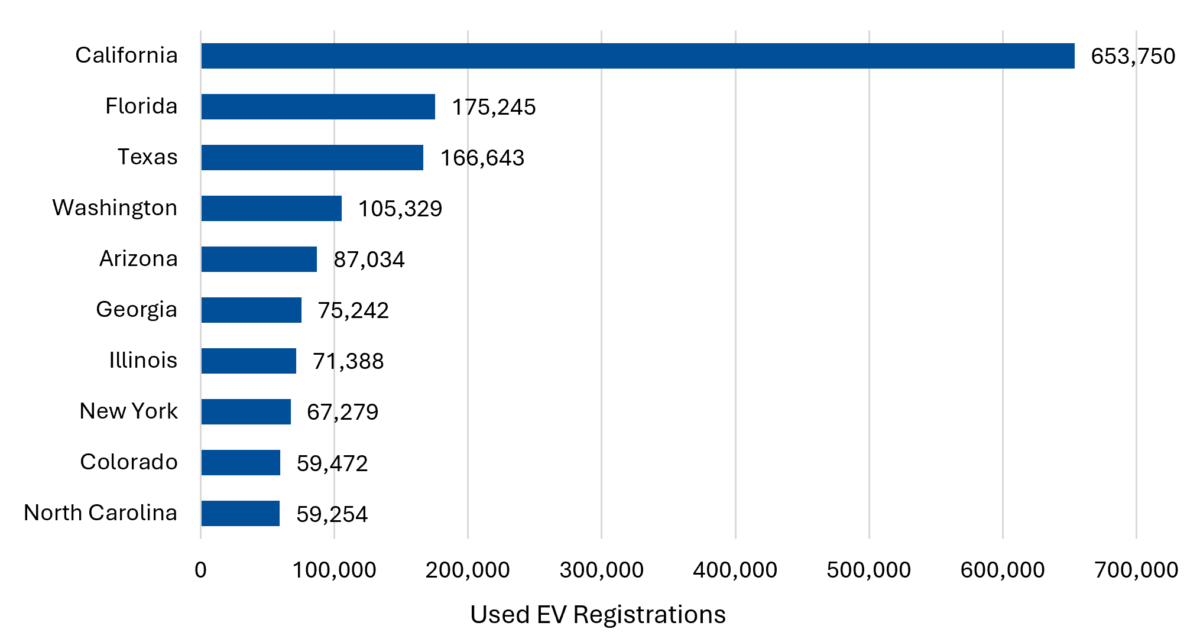
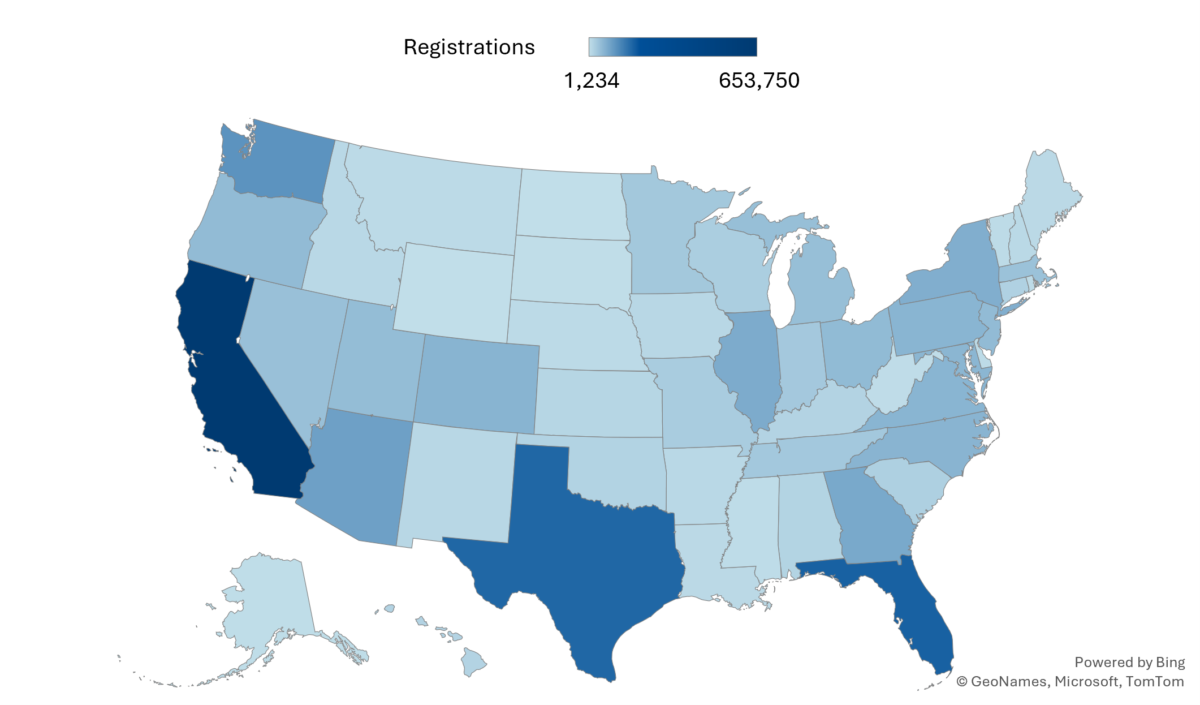
Used EV registrations are concentrated in a small number of states. As shown in Figure 4, California recorded approximately 654,000 used EV registrations between Q1 2020 and Q1 2026, nearly four times as many as Florida, the second-largest market. For context, the California Department of Motor Vehicles reports that 2,236,896 EVs were on the road in 2025, meaning that used EVs registered since 2020 make up at least a quarter of EVs on California’s roads. Florida and Texas recorded approximately 175,000 and 167,000 registrations, respectively, followed by Washington with about 105,000. Registration totals were more closely grouped among the remaining states in the top ten.
Source: Experian used vehicle registrations.
Below the three largest states, the leaders of the used vehicle market are not necessarily the strongest leaders in the new market. Some East Coast states with a strong presence in the new market have weaker used markets. For example, New Jersey has the fifth strongest new EV market but is ranked 16th among states in the used EV market. On the other hand, states like Washington, Georgia, and Arizona rank higher in the used market than the new market. These differences indicate that new EV sales are not the only factor shaping state used EV markets. Interstate vehicle flows, vehicle availability and affordability, state and utility incentives, and broader regional transportation patterns may also influence where used EVs are ultimately purchased and registered.
Figure 5: Total Used EV Registrations by State (Q1 2020 to Q1 2026)
Source: Experian used vehicle registrations.
Several States Have Explored Incentives, Often Targeting Specific Barriers
State incentives may help expand access to used EVs, particularly following the expiration of the federal Previously Owned Clean Vehicle Credit. However, statewide incentives for used EVs remain relatively uncommon. Where available, these programs are often limited to income-qualified households, tied to the trade-in of an older vehicle, or limited by annual funding availability. These limits can improve targeting and control costs, but they can also reduce participation, create administrative complexity, and make programs harder for auto dealers and households to navigate.
State EV incentives often target low-income buyers. For example, Connecticut’s CHEAPR incentive offers funding up to $5,000 for used EVs based on buyer’s income. Vehicle trade-in programs have also become popular used EV incentives such as Colorado’s Vehicle Exchange Program offering up to $6,000 for used EVs conditional on trading in an eligible older or higher-emitting gas vehicle. California, which has the highest registrations of both new and used EVs, has employed several different incentive programs including the now closed Clean Vehicle Rebate Project, which offered $7,500 for new vehicles from 2012 to 2023, and the still active CleanCars4All trade-in program that applies to new or used vehicles. These programs direct funding toward households rather than providing universal rebates to all used EV buyers. California’s recently implemented first-time EV buyer rebate will target incentives towards those who have never owned an EV before, applying to both new and used EV sales.
Washington State’s 2024 EV Instant Rebate Program demonstrates both the potential demand for point-of-sale assistance and the limitations of fixed budgets. The income-qualified program opened on August 1, 2024, and exhausted its $45 million allocation in less than 90 days, with participation reaching three times the state’s forecast. The program included incentives for used EV purchases as well as new EV purchases and leases. Its rapid uptake suggested substantial interest in upfront purchase assistance, although the program’s short duration limits the extent to which it can explain longer-term used EV registration trends in the state.
At the same time, large used EV markets can develop in states without broad used-vehicle purchase incentives. Texas and Florida ranked second and third in total used EV registrations over the period analyzed, despite offering limited statewide purchase support for used EVs. Texas’s Light-Duty Purchase or Lease Incentive Program serves only new vehicles and is limited by funding; while Florida’s only incentive existed until July 1st, 2025 and allowed EVs to drive in express lanes. The strength of Texas and Florida’s used EV markets may therefore be due to the downstream effects of their large new EV market.
Tesla Leads the Used EV Market, but Others are Gaining Ground
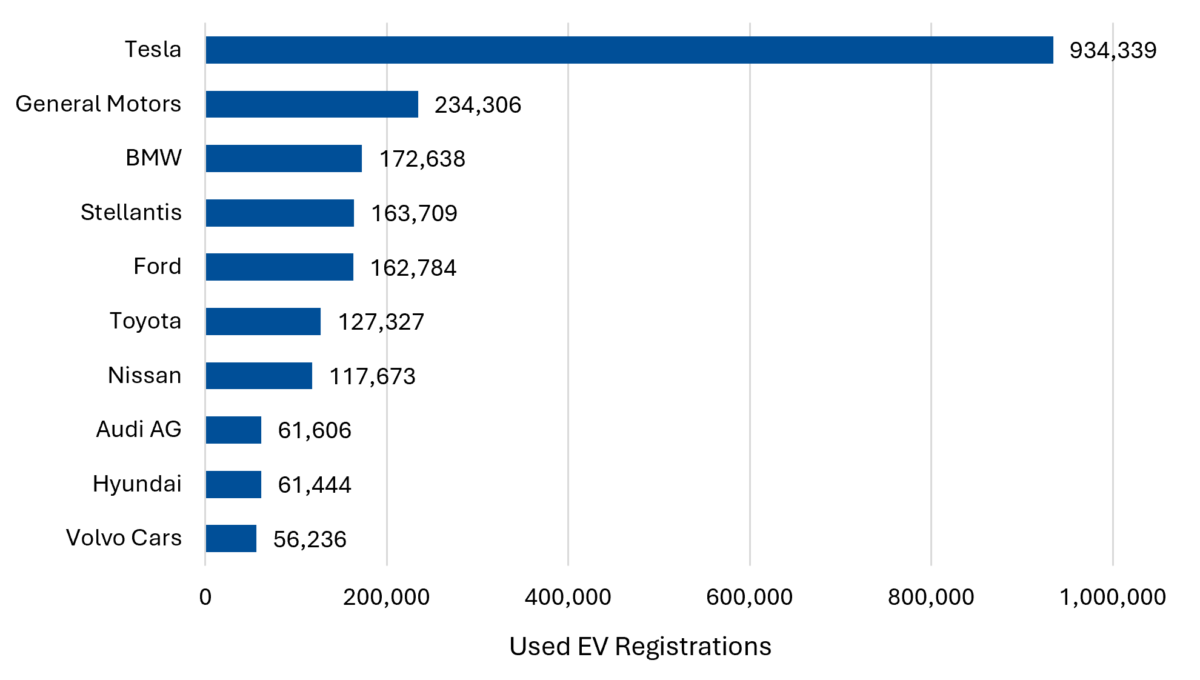
Competition between manufacturers has historically been concentrated within a handful of companies. As shown in Figure 6, Tesla has recorded more than 934,000 used EV registrations between Q1 2020 to Q1 2026, almost four times more than its closest competitor, General Motors. General Motors has about 60,000 more registrations than BMW, Stellantis, or Ford, which represent similar portions of the used EV market.
Figure 6: Top Ten Manufacturers for Total Used EV Registrations (Q1 2020 to Q1 2026)
Source: Experian used vehicle registrations.
Market Competition Grows
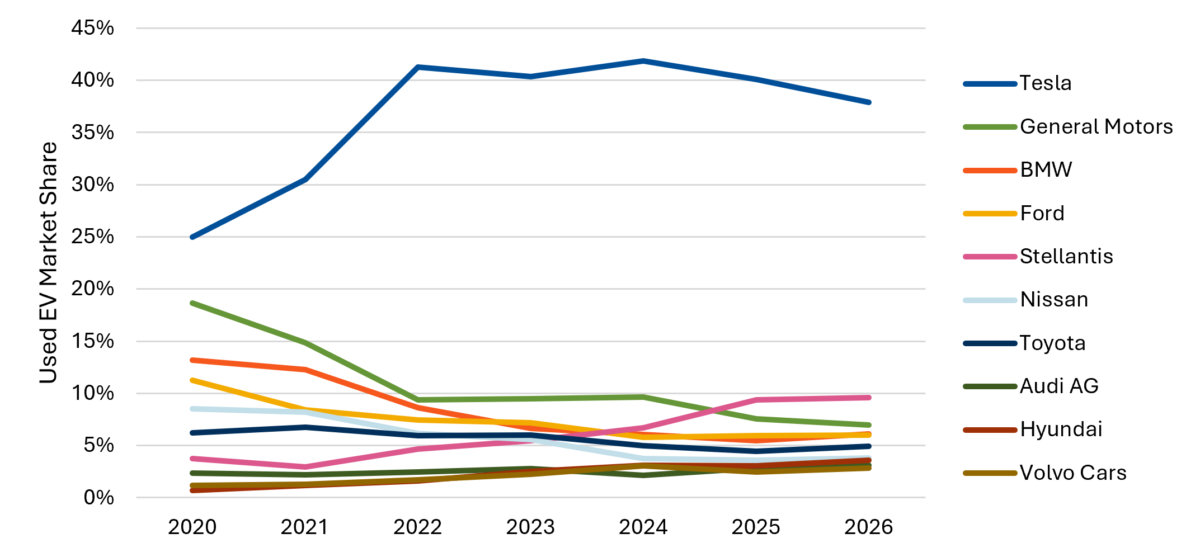
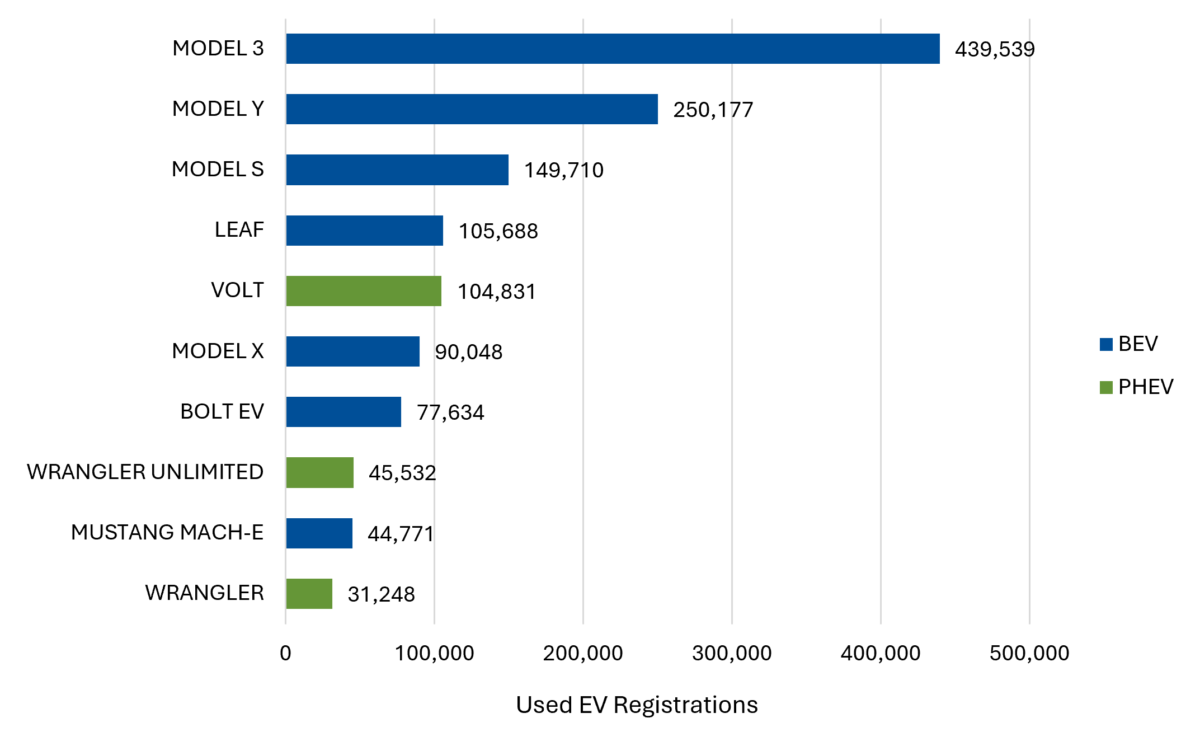
Not only does Tesla account for the largest share of used EV registrations between Q1 2020 and Q1 2026, but its lead has been relatively consistent. At least 25 percent of used EVs registered for the last six years have been manufactured by Tesla with a peak of about 42 percent in 2024. As shown in Figure 7 and Figure 8, Tesla has manufactured the three most registered models over the period studied and the Model 3 has been the most registered vehicle every year besides 2020.
Figure 7: Used EV Market Share by Year for Top 10 Manufacturers
Source: Experian used vehicle registrations.
Figure 7 shows the changes in market concentration over 2020–2026 with 2023–2024 being the most dominant period for General Motors and Tesla. 2025 reversed this trend as Tesla and General Motors both experienced a loss in market share, which was absorbed by Stellantis and companies like Audi and Hyundai. Stellantis has experienced the fastest growth in the used EV market, jumping from the seventh-ranked company to second between 2023 and 2025. Stellantis has been most successful with their line of PHEVs: the SUV Jeep Wrangler, Wrangler Unlimited, and minivan Chrysler Pacifica. As the used EV market has expanded, not only has competition become tighter, but more models are able to meet consumer demand for technology and vehicle type.
Figure 8: Top Ten Models for Total Used EV Registrations (Q1 2020 to Q1 2026)
Source: Experian used vehicle registrations.
As shown in Figure 8, Tesla accounts for four of the ten most registered used EV models, underscoring the company’s strong presence in the used EV market. Stellantis is the only other manufacturer with more than one model represented among the top ten, highlighting the concentration of registrations among a relatively small group of vehicle models. Vehicle age also appears to be an important factor influencing used EV registrations. Several of the most registered models, including the Tesla Model S, Nissan Leaf and the Chevrolet Volt, have been available for many years, allowing larger vehicle populations to accumulate in the market. Notably, none of the top ten used EVs were originally released after 2021. The influence of age in the market still holds until 2025, when four of the ten most registered were released after 2020. The models available in the used market must first be circulated through the new market, meaning vehicles with high supply and buyer familiarity are favored by buyers. Both supply and familiarity improve with age on the market.
The Future of the Market and Policy Implications
Currently 76 percent of vehicle owners drive a used car and with the percentage of used sales expected to grow, a mature used market is an important avenue for EV adoption. Used EVs have become more affordable, with early 2026 reporting suggesting that the average used EV was priced within $1,300 of gas-powered vehicles.
The supply of used EVs is expected to grow in the coming years. Before its expiration, the Commercial Clean Vehicle Credit enabled leasing companies to claim federal incentives on leased EVs, leading to more than a million new leased EVs between 2023 and 2025. Because many vehicles leases last approximately three years, a growing number of those leased vehicles are expected to enter the used market in the coming years, increasing inventory and expanding consumer choice.
Over the last six years, the used EV market has developed from a niche segment of the market to an affordable pathway to EV adoption for many buyers. The growth of this market has supported a greater diversity of manufacturers, body types, and models, serving different consumer needs. State-level programs, including used EV incentives and vehicle trade-in initiatives, have the potential to further improve accessibility and affordability. As used EV inventory continues to expand and consumer interest grows, the used market may play an increasingly important role in broadening access to vehicle electrification in the United States.
Correction: This article was updated on August 10, 2026. An earlier version of this article incorrectly reported that the average price of a used EV was within $1,400 of a gas-powered vehicle. The correct figure, per 2026 reporting from Cox Automotive, is $1,300.