In February, consumer research firm JD Power published their 2026 U.S. Electric Vehicle Experience (EVX) Ownership Study, measuring customer satisfaction among electric vehicle (EV) drivers during their first year of ownership. Despite a turbulent year for the EV market, battery electric vehicle (BEV) owners surveyed reported the highest rates of overall satisfaction since the study’s inception in 2021. As the economic landscape changes in 2026, an increasingly positive experience among EV owners may help to reshape the long-term trajectory of the EV market.
EV Owner Satisfaction Is Strong
The 2026 U.S. Electric Vehicle Experience (EVX) Ownership Study surveyed owners of 2025 and 2026 model-year BEVs and plug-in hybrid electric vehicles (PHEVs) in late 2025. Engaging EV owners of both premium and mass market brands during their pivotal first year of ownership, the EVX Ownership Study collects data across factors that influence owner experience, such as vehicle quality, overall costs, and ease of charging.
BEV owner satisfaction reached an all-time high in 2026, with 96 percent of BEV owners responding that they would consider purchasing or leasing a BEV again. While premium BEVs score higher than mass market BEVs, both segments notably outrank PHEVs on overall satisfaction.
Yet satisfaction among current BEV owners has not fully carried over to prospective buyers. Previous research from JD Power’s 2025 U.S. Electric Vehicle Consideration Study found that 24 percent of vehicle shoppers would be “very likely” to consider purchasing an EV and 35 percent were “somewhat likely,” with over half naming charging station availability as a major concern. In contrast, BEV drivers in the 2026 EVX Ownership Study reported record-high satisfaction with the availability of public charging.
While expanded charging infrastructure has attempted to resolve the concerns of prospective EV buyers, light-duty BEVs held just 7.7 percent of vehicle market share in 2025, down slightly from 7.9 percent in 2024. The disconnect between prospective buyers’ concerns and reported satisfaction among current EV owners highlights a central challenge for the EV market; positive owner experience has not yet translated into widespread BEV adoption.
A Volatile Market
In the past year, we have talked a lot about fluctuating EV sales, amid economic concerns and significant changes to federal policy. In Q3, sales of light-duty BEVs saw a 27 percent increase from the same period in 2024, as consumers rushed to purchase an EV before the $7,500 federal tax credit expired at the end of September. In contrast, the market experienced a slowdown in Q4, with sales falling 50 percent from the previous quarter, a 38 percent decrease from Q4 sales in 2024.
Some automakers have responded to the drop in demand by limiting their EV lineups in 2026. Tesla recently announced the discontinuation of its flagship Model S and Model X, which paved the way for the company’s rise as a major automaker and helped usher in the current era of EVs. The mass market sector has also seen notable cuts, including the cancellation of several all-electric models from the Hyundai Motor Group. These decisions represent a broader trend across the EV market toward fewer vehicle options, especially at an affordable price point.
Looking Ahead
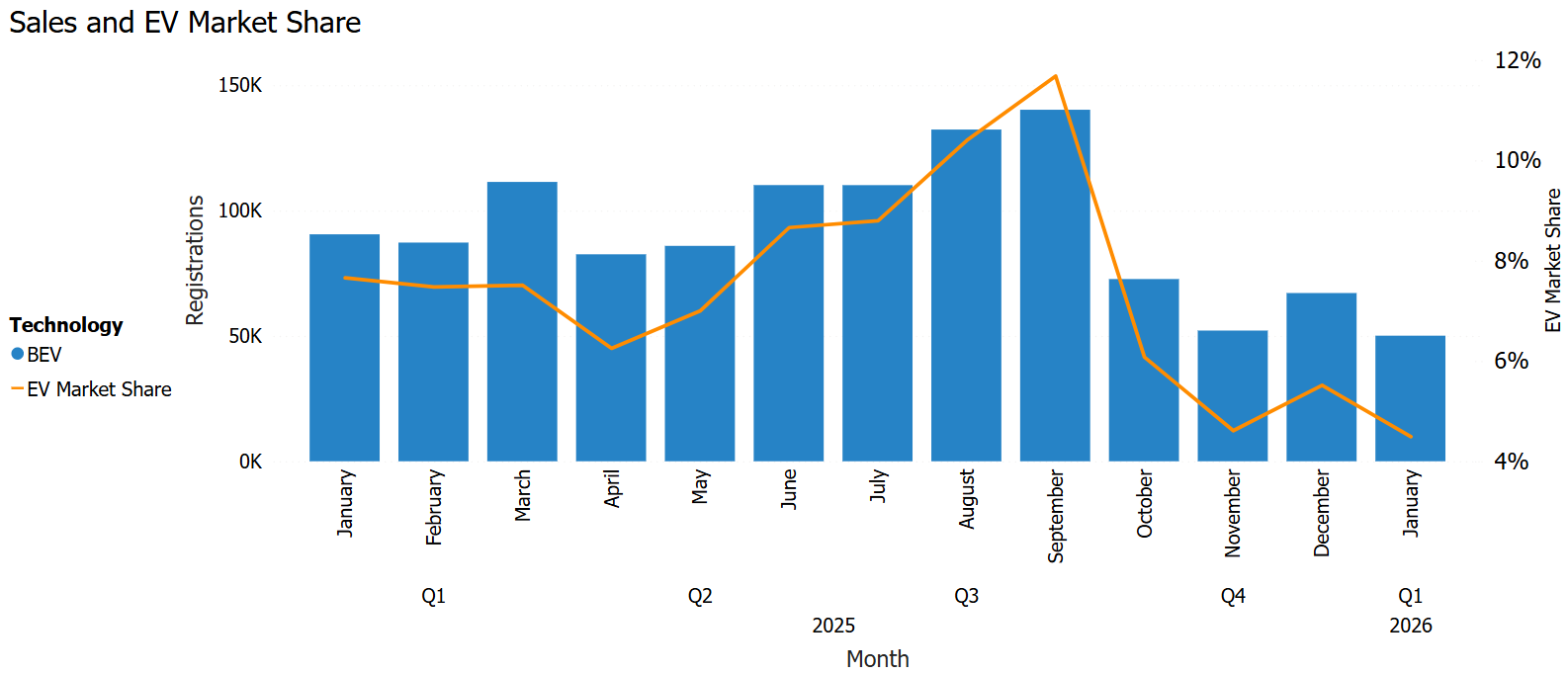
In a digest last month, reviewing sales data from Q4 of 2025, we noted an uptick in the market in December, following a low point for light-duty EV sales in November; sales of light-duty BEVs rose from 52,000 in November to 67,000 in December, a 29 percent increase (Figure 1). Yet new data from the first month of 2026 shows that the market hasn’t stabilized yet. Light-duty BEV sales in January were 50,078 a 25 percent decrease from December and a 45 percent YoY decrease from January 2025.
Figure 1. Light-duty BEV sales, January 2025 through January 2026
Source: EV Hub Market Dashboard
In the last few weeks, however, EVs have come back into the spotlight as gasoline prices have spiked, reaching a national average of almost $3.80 per gallon. One vehicle research site shows that consumers may already be responding to higher prices at the pump; EV research activity grew to 2.4 percent of all vehicle research conducted on the website in the first week of March, compared to 20.7 percent in the week prior.
We will be closely monitoring sales trends throughout 2026 as new data comes in—be sure to stay up-to-date on our EV Market Dashboard.