Image Source: Shutterstock
China is winning the Race for Clean Energy Leadership, finds a new report from my colleagues at Atlas. Released last week as President Trump touched down in Beijing to begin talks with Chinese President Xi, the report finds that China has tipped the scales of the global clean tech supply chain. My colleagues identified nearly $1.1 trillion in global manufacturing investments from 2019 to 2025, across batteries, solar, electric vehicles (EVs), and wind. From the analysis, China comes out ahead in all four sectors, with $509.7 billion in announced investment—more than Europe, North America, South America, Oceania, and Africa combined. While clean energy and EVs have seen a slowdown here at home, global demand is growing rapidly, positioning China to play an outsized role in the market worldwide.
China is no longer just participating in the clean energy economy—it is increasingly shaping where and how production happens. Investments by Chinese companies accounted for 55 percent of tracked manufacturing announcements, which spanned more than 500 companies across 54 countries. As American investment in clean energy falls further behind—seeing more cancelations than new investments in 2025—the world is more reliant than ever on clean tech from China. And with Chinese companies investing $136 billion overseas to unlock new markets for manufacturing and deployment, the global supply chain for clean energy is increasingly concentrated.
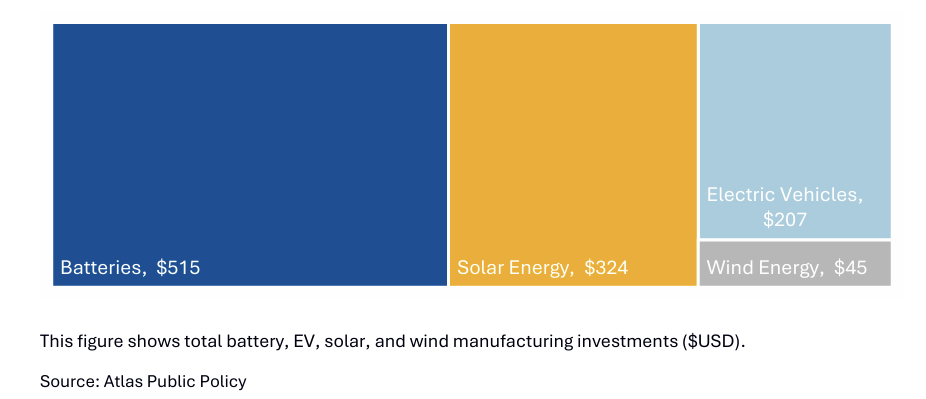
This dynamic is especially visible in the EV market, where targeted investment is flowing into both batteries and vehicle manufacturing. Batteries alone drew $515 billion in global investment—the largest share of any sector—illustrating their importance for both EVs and energy storage. EV manufacturing accounted for another $207 billion.
Figure 1: Announced Global Manufacturing Investment from 2019 to 2025
Two Chinese firms sit at the center of the investment story: battery maker CATL and EV giant BYD, which rank first and second among all companies tracked in the report. After large-scale investments at home, both companies are expanding beyond the country’s borders. CATL opened its first foreign factory in Germany in 2019 and BYD hopes to reach 50 percent international sales by 2030. That growing footprint gives Chinese manufacturers an edge as EV demand rises.
In the last few months, the conflict in Iran has caused gas prices to soar, a hardship felt by drivers around the world. U.S. average gas prices exceed $4.50 a gallon, which has strained Americans’ wallets and caused overall car sales to tumble. Yet since the conflict began in March, EV sales have been higher than in the previous months of 2026, and interest in used EVs has risen substantially. Elsewhere, worldwide EV sales are booming. Europe, for example, which faces higher fuel prices than the United States, saw sales of EVs grow by 27 percent in April, compared to 2025. This surge in consumer demand reinforces the growing importance of battery and EV supply chains in the global energy market.
As investment, production, and demand all move in the same direction, China is gaining an even stronger grip on the industries that will shape the future of energy. Though currently unavailable in the United States due to national security laws and a high tariff rate, Chinese EVs are raising alarms among some American automakers and lawmakers as they enter the market in Canada and Europe. As U.S.-China relations navigate a changing geopolitical landscape, shaped by mounting disruptions to global supply chains and energy markets, the race for clean energy leadership may matter now more than ever.