Paving the Way: Enabling Equitable Electric Vehicle Shared Mobility Programs
Moe Khatib2022-06-17T19:38:56-04:00Case studies of exceptional equitable EV shared mobility programs with support for public-private partnerships in EV deployment.
Case studies of exceptional equitable EV shared mobility programs with support for public-private partnerships in EV deployment.
The Run on Less – Electric demonstration demonstrated that for four market segments — vans and step vans, medium-duty box trucks, terminal tractors, and heavy-duty regional haul tractors — the technology is mature enough for fleets to be making investments in production CBEVs. Continuous improvement is expected to be rapid as these technologies gain market share. The environmental benefit of reduced CO2 and particulate emissions is significant for replacing traditional diesel and gasoline-based vehicles.
Case studies for EVSE installation at multi-family properties in lower- to moderate-income communities.
A case study of EV deployment in Des Moines, Iowa's cold climate.
As we approach the all-important COP26, the report calls for businesses to lead from the front and for every company with a fleet or employee car scheme to join EV100 and commit to going electric.
EVHybridNoire and Clean Fuels Ohio developed a joint report detailing the attitudes, beliefs, and knowledge of next generation mobility in the Greater Cleveland area to identify unmet transportation needs in target communities.
This report offers the first comprehensive assessment of how major US fleet managers are approaching the electrification of their fleets. It is based on RMI’s survey of 91 fleet managers operating large fleets, as well as 18 in-depth interviews conducted with fleet managers representing a cross-section of fleet types.
Examples of state governments in the U.S. pursuing equity-centered EV initiatives in LMI communities.
In this follow-up report we discuss ways to quickly and efficiently bring TE benefits to the communities that need them most. Using Chicago as an example, we examine the problem of air inequality and suggest policies and programs to make TE a key part of the solution.
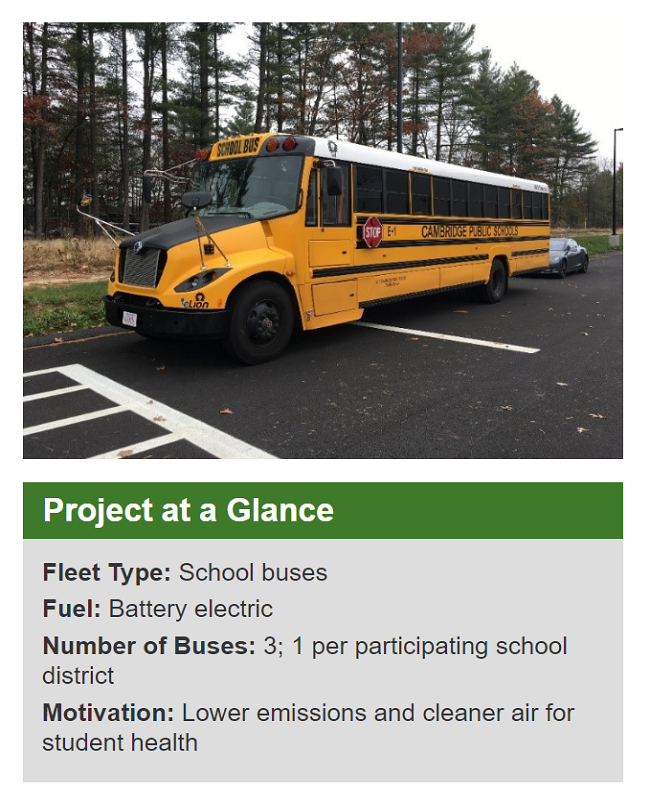
A $2 million pilot project, funded through the Regional Greenhouse Gas Initiative, allowed three school districts to purchase Type C electric school buses and Level 2 bidirectional vehicle-to-grid (V2G) charging stations to test the technology in cold weather environments in Massachusetts.