Source: Transportation Electrification in the Southeast
Earlier this month, my colleague Matthew Vining and I published our sixth annual Transportation Electrification in the Southeast report, produced in partnership with the Southern Alliance for Clean Energy (SACE).
At a critical moment in the electric vehicle (EV) market politically, this year’s report assesses how states in the Southeast – Alabama, Florida, Georgia, North Carolina, South Carolina, and Tennessee – are making transportation electrification progress across six key market indicators: manufacturing investments; manufacturing jobs; EV sales; charging infrastructure deployment; utility investments; and public funding.
Drawing data from Atlas EV Hub and EV Jobs Hub from July 2024 through June 2025, the report highlights five key data stories, outlined below.
-
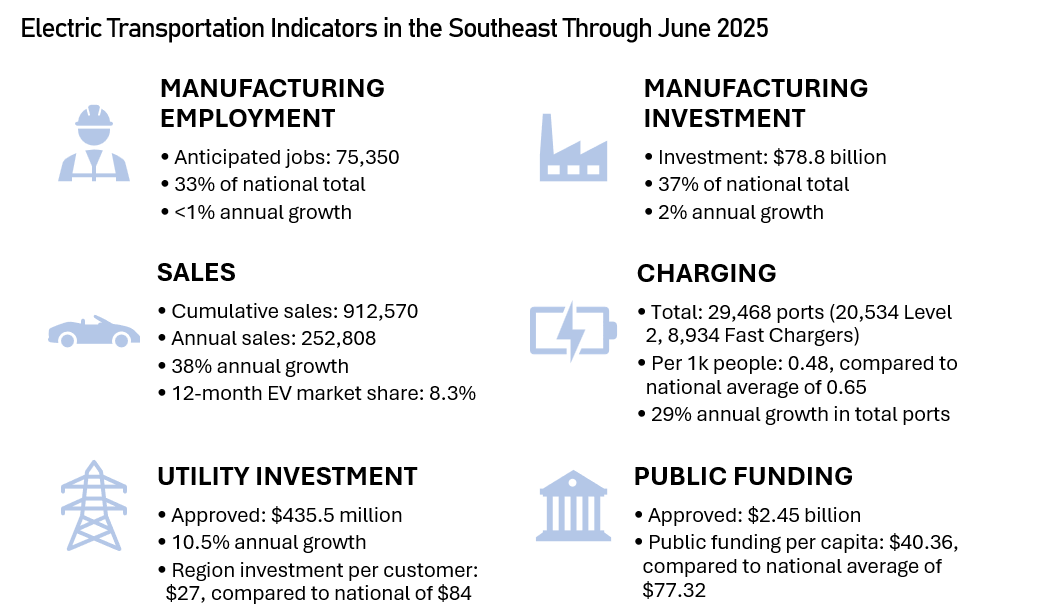
The Southeast region continues to capture massive EV and battery manufacturing momentum, with nearly $80 billion in private-sector investment (37 percent of the national total) and 75,000 projected jobs (33 percent of the national total). States are seeing both major facilities moving forward to production and planned projects also being canceled.
-
Sales in the region continue to climb, serving as proof that the demand for EVs is there. Passenger EV sales jumped 38 percent year-over-year, reaching 8.3 percent market share region wide, with Florida outpacing the U.S. at 10.3 percent. Commercial EV sales also hit a record high in Q2 2025, driven by the electrification of delivery vans and other medium-duty fleets.
-
The Southeast added over 2,600 new DC fast charging ports in the past year – a 41 percent jump – even as federal National Electric Vehicle Infrastructure (NEVI) funds remain in limbo under the Trump Administration. Alabama in particular recorded impressive growth of public DCFC deployment with an 81 percent surge in the past 12 months.
-
Investor-owned utilities (IOUs) have secured $6.6 billion for transportation electrification nationwide, with Southeast IOUs contributing $436 million (7 percent of the national total). IOU EV investments in the Southeast rose 10.5 percent year-over-year, but the region still lags the national average in per-customer investment and strategic planning, leaving it at a competitive disadvantage.
-
Under the Biden Administration, federal funding for transportation electrification rose 25 percent to $2.2 billion in awarded and allocated funds for charging network expansions, electric bus deployments, and replacing old gas and diesel fleet vehicles with electric options.
What does this all mean for the EV market in the Southeast and across the U.S.?
In a blog post summarizing the report and projecting trends for the EV market, SACE’s Stan Cross noted, “[T]he electric horse has left the barn. Though anti-EV politics may slow the market in the near term, the gallop achieved over the past four years is likely to propel the market forward, regardless.”
Further, Atlas founder Nick Nigro joined Stan Cross and Dory Larsen from SACE on September 16th to discuss the state of the EV market and look ahead at 2026, using data from the report. View the webinar recording here.
The full report can be found here, and state-specific fact sheets can be found here.