Image Source: Atlas EV Hub
December 2025 sales data is now live on our EV Market Dashboard, meaning we now have a complete picture of 2025 EV sales. With the federal purchase tax credit no longer available as of the late-September sunset, the final quarter of 2025 offers one of the clearest “stress tests” yet for baseline demand. Below are four data stories that stood out in the latest refresh.
First, sales slowed in Q4, but December reversed the worst of the slide.
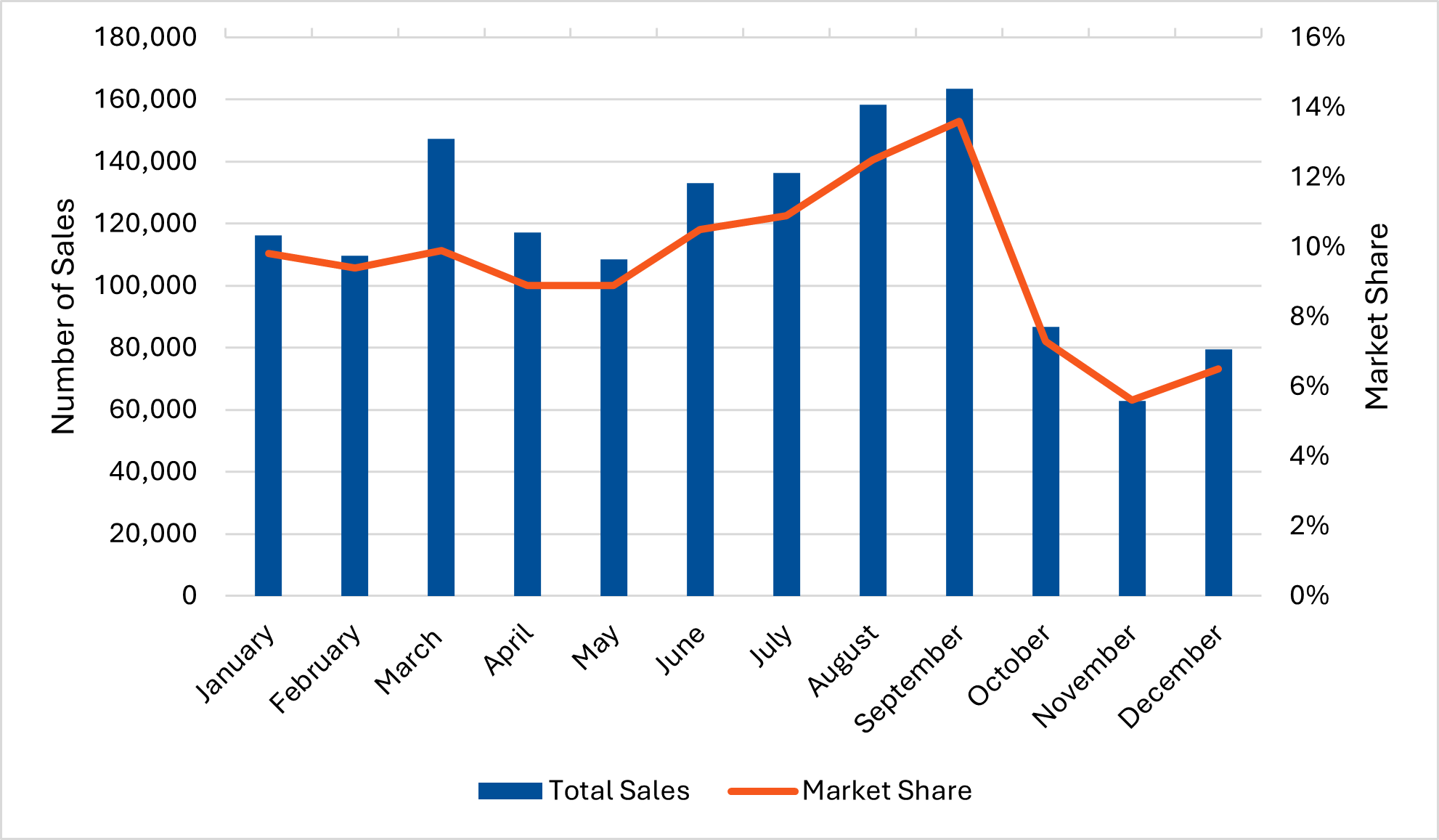
Across Q4 2025, light-duty EV sales totaled 229,185, down substantially from Q4 2024 (399,594). The quarter started with a steep reset: EV sales fell from 163,442 in September to 86,740 in October, then hit a low point in November at 62,910 before recovering slightly to 79,531 in December.
Q4 was challenging overall, but December sales rose about 26 percent from November, offering some hope that demand hasn’t entirely declined. Still, the last time light-duty EV monthly sales in the U.S. were under 80,000 was mid-2022, when there were fewer models and less charging infrastructure. For some context: in Q2 2022, 30 makes and 79 models were available; by Q4 2025, this has increased to 47 makes and 152 models on the market.
Figure 1. Total EV Sales in 2025
Second, the Q3 peak looks increasingly like demand was pulled-forward.
Just before the sunset of federal EV tax credits, EV sales surged: Q3 2025 reached 458,298, the highest quarterly total the EV Market Dashboard has ever recorded. Immediately afterward, however, sales dropped sharply in Q4. Taken together with reporting on automaker expectations for sales around credit expiration, the pattern is consistent with a pull-forward dynamic of buyers accelerating purchases ahead of an incentive deadline, followed by a Q4 hangover. We’ll keep watching early-2026 data to see how much of Q4 represents a one-time adjustment versus a new baseline.
Third, Tesla still owns the top of the leaderboard, but the Chevrolet Equinox EV has established itself as a clear affordable frontrunner in the market.
Since 2022, the Tesla Model Y and the Tesla Model 3 have remained the most popular EVs on the market, with 357,453 registrations and 161,915 in 2025, respectively. However, a non-Tesla contender worth taking a closer look at is the Chevrolet Equinox EV, coming in with 60,052 sales in 2025 ahead of several other models including the Ford Mustang Mach-E (51,057) and Hyundai Ioniq 5 (46,273).
Recent coverage points to a pretty plausible explanation for why the Equinox EV is in third for sales: it’s positioned as a comparatively affordable, mainstream electric SUV at the center of the market, and reviewers have consistently framed it as having strong range-for-the-price value. GM also credited the Equinox EV demand as a driver of record monthly EV sales in July 2025, and the Equinox led non-Tesla EV sales in Q2-Q3 2025. Of particular significance, the Equinox is the first EV to rank third in the annual sales summary with an estimated price below $35,000. From 2021 through 2024, electric vehicles occupying third place in annual sales have all had an estimated price exceeding $50,000.
Fourth, states with an EV market share above 10 percent dropped in Q4.
To provide context, in the fourth quarter of 2024, thirteen states reached or exceeded a 10 percent EV market share. These states included California, Colorado, DC, Washington, Oregon, Nevada, Hawaii, New Jersey, Vermont, Massachusetts, Maryland, Connecticut, and New York.[1] In Q4 2025, only six states broke 10 percent (DC, California, Washington, Nevada, Hawaii, and Oregon) representing a significant reduction in for Q4 2025, not just a reordering among the top states.
Despite the sharp decline in Q4, the annual data for 2025 shows that ten states overall maintained an EV market share above 10 percent: California, DC, Colorado, Washington, Nevada, Oregon, New Jersey, Hawaii, Massachusetts, and Connecticut. So while the final quarter of 2025 reflected a notable pullback, the overall year still demonstrates a broader presence of states with double-digit EV market share.
Looking Ahead
As the market transitions in the aftermath of the federal purchase tax credit sunset, ongoing monitoring will be essential. We will continue to track 2026 developments as the EV market adapts to these changes. For additional insights, including model leaders, state-by-state trends, and monthly or quarterly data breakdown, check out the latest data on the EV Market Dashboard.
[1] DC is considered a state in the EV Market Dashboard for the purposes of data visualization.