Image Source: Clean Economy Tracker
Clean energy deployment in the United States continues to accelerate at a historic pace. According to Atlas’s Clean Economy Tracker, which includes Q4 pipeline projects and a broad set of renewable technologies, the full-year total will reach 64 GW of new generation being added to the grid, with clean tech accounting for approximately 58 GW – or just under 91 percent (see Figure 1).
At the same time, there are concerns over rising electricity prices and new load added to the grid from data centers. In Q3, electric vehicle (EV) sales set a quarterly record, so how does this contribute to load concerns? In this Digest, we dive into this issue and how EVs could actually help alleviate affordability and grid concerns.
Figure 1. Net Power Capacity Over Time
Data Source: United States Energy Information Administration
Affordability and electricity prices are a big concern
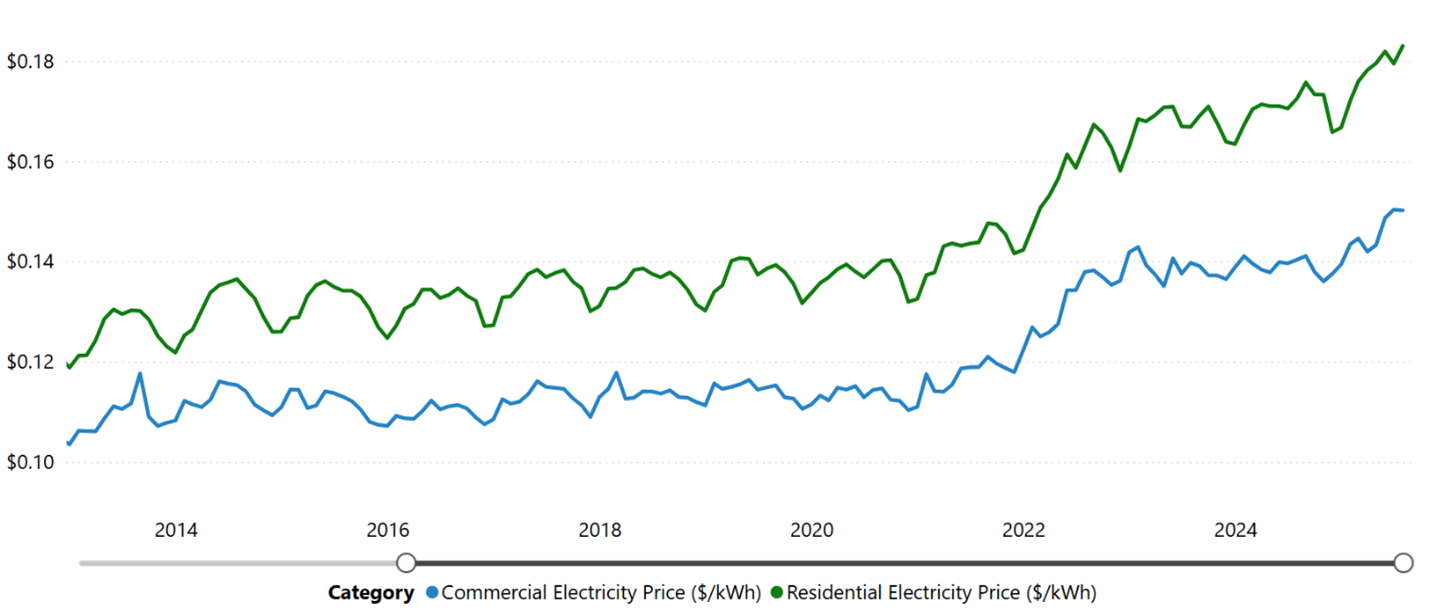
Amid this buildout, however, electricity prices are still rising, and the impacts vary widely by region. EV Hub’s Market Factors Dashboard shows that as of August 2025, residential electricity rates ranged from $0.11/kWh in Texas and Louisiana to $0.39/kWh in Hawaii. Nationally, average residential electricity prices climbed from $0.167/kWh in January to $0.183/kWh in August 2025, a nearly 10 percent increase in just eight months (see Figure 2).
Figure 2. Residential Electricity Price ($/kWh) and Commercial Electricity Price ($/kWh) as of August 2025
Clean energy helps buffer fuel price volatility, but it’s not the only driver of utility bill costs. Local grid mix, infrastructure investments, policy choices, and how utilities recover costs all contribute to persistent price differences. States with higher shares of renewables don’t automatically have the lowest prices, but they tend to experience less volatility when fossil fuel prices spike.
Source: Market Factors Dashboard
EVs, New Loads, and the PJM Challenge
Recent growth in both vehicle electrification and data center construction is adding new, often concentrated loads to the grid. However, there’s a potential solution lying in right the driveway: with the right policies and rate designs, EVs can ease these pressures rather than worsen them. A 2023 study by the California Public Advocates Office found that while distribution upgrades to support transportation electrification could cost around $26 billion through 2035 in the state, the resulting increase in electricity sales can put net downward pressure on average residential rates. A 2024 U.S. Department of Energy report to Congress reached a similar conclusion, describing EVs as a flexible, “symbiotic” resource for the grid that can improve asset utilization and support affordability and reliability when charging is managed. Investment tracked on EV Hub’s Utility Filings Dashboard shows this is not just theoretical. Across investor-owned utilities, more than $4.5 billion in approved funding is aimed at advancing Vehicle Grid Integration (VGI), including programs that steer EV charging to periods of abundant renewable generation and away from evening peaks.
PJM’s EV Fleet as a Potential Grid Resource
PJM states – the nation’s largest grid operator managing power for over 65 million Americans across Pennsylvania, New Jersey, Maryland, Ohio, Virginia, and Illinois – collectively account for more than 850,000 EVs sold as of Q3 2025. That fleet is effectively a distributed network of batteries spread across neighborhoods, businesses, and fleets. If even a fraction of those vehicles charge in response to price signals or managed charging programs, they can help smooth net load, reduce peak demand, and support reliability.
As this energy landscape continues to shift, we’ll continue to help stakeholders track progress on the power deployment and utility interconnection front.