Two weeks ago, the Environmental Protection Agency (EPA) announced plans to repeal the Endangerment Finding – the determination that greenhouse gases endanger public health and welfare. That finding is the legal backbone for numerous climate regulation policies in the United States, including how EPA sets limits on pollution from vehicles.
EPA Administrator Lee Zeldin said that emission standards are “the real threat to Americans’ livelihoods” but analysis by CBS News suggests that that the opposite may be true. According to data from the U.S. Energy Information Administration (EIA), repealing the Endangerment Finding may have detrimental economic impacts.
To understand these potential impacts, we can look at EIA’s latest Annual Energy Outlook (AEO) which projects potential trends in future energy consumption and supply, including vehicle fuel economy and emissions. It considers two scenarios: the Reference case, which takes into account laws and rules on the books as of December 2024, including the Endangerment Finding, and the Alternative Transportation case which considers how projections would change without these regulations.
The Alternative Transportation case simulates a scenario in which EPA’s light-duty tailpipe emissions standards, National Highway Traffic and Safety Administration’s (NHTSA) fuel economy standards, and California Air Resources Board’s zero-emission vehicle sales requirements for trucks are not in place, new electric vehicle (EV) models and EV charging infrastructure are based on growth in EV sales and registrations rather than announced public and private sector plans, and manufacturer reshoring of EV and battery supply chains has a slower uptake than in the Reference case.
Below are some of the potential market developments that AEO notes could occur under the Alternative Transportation scenario.
Higher gasoline prices under rollbacks
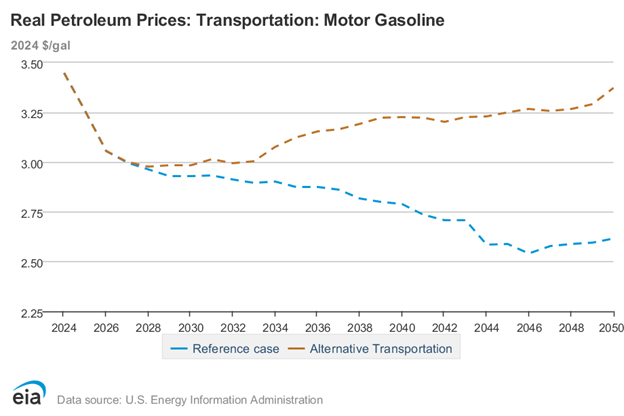
Real retail gasoline prices are notably higher over the next two decades in the Alternative Transportation case than in the Reference case, as shown in Figure 1. With fewer EVs on the road and slower efficiency gains in gasoline models, gasoline demand climbs and that extra demand shows up as higher pump prices.
Figure 1. Annual Energy Outlook’s Future Gas Prices