Image Source: Shutterstock
Last month, my colleague Rachel Reolfi published an issue brief that thoroughly examined the availability of affordable new vehicles in the United States over the past decade. The study found that high sticker prices are not exclusive to electric vehicles (EVs). Instead, prices have been increasing across all types of powertrains. Drawing on data from fueleconomy.gov, the brief highlights several significant trends affecting new vehicle affordability in the U.S. market. We’re highlighting several key findings below; for the full results, read the issue brief here.
The Shrinking Lower End Market
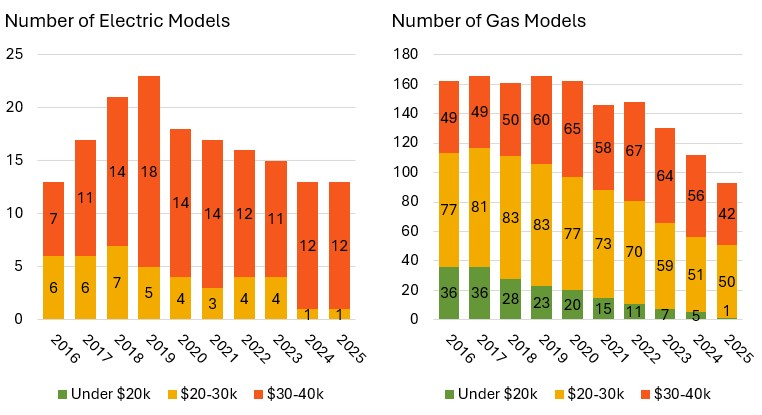
The lower end of the vehicle market has contracted dramatically over the last ten years. Specifically, new vehicles priced under $20,000 have nearly disappeared (see Figure 1). As of 2025, the Nissan Versa stands as the sole gasoline-powered model remaining below this threshold, and even then, production of its most affordable configuration is coming to an end. The analysis also pointed out that there has never been an EV sold in the U.S. for under $20,000.
Figure 1. Number of Available Models under $40,000 from 2016-2025, for Electric and Gas Vehicles
Source: Atlas analysis of fueleconomy.gov data.
When adjusting manufacturers’ suggested retail prices (MSRPs) to 2025 dollars, the study noted diverging trends between electric and gas vehicles. EV models available for under $40,000 are still relatively scarce, but their numbers have increased since 2016. Conversely, the number of base-trim gasoline models has declined since 2016.
Rising Transaction Prices
Data on transaction prices cited in the brief show a steady increase in nominal terms since at least 2012, with the average purchase price reaching just above $50,000 by September 2025 which underscores the ongoing affordability squeeze faced by new vehicle buyers.
With Federal Tax Credits, the EV Premium Narrowed Considerably
Although EVs continue to have higher average transaction prices than gasoline vehicles, the study found that this gap has narrowed since 2022. When federal incentives were active, the prices of some EVs were at parity – or even fell below – the prices of similar gasoline vehicles.
Battery Costs and Vehicle Pricing
In parallel, battery pack costs have declined for EVs. However, the study notes that these savings have not been directly reflected in lower EV prices. Instead, automakers appear to have reinvested these cost savings into larger battery packs and increased vehicle range. Between 2016 and 2025, the average range for battery electric vehicles (BEVs) rose from about 110 miles to approximately 287 miles, with average battery capacity more than tripling (see Figure 2). Consumer demand for a vehicle range near 300 miles and the growing preference for crossovers and SUVs have further contributed to upward pressure on MSRPs.
Figure 2. Estimated Average Battery Size and Range for Base Model BEVs from 2016-2025

Average range and battery size are based on base models only and not weighted by sales. Battery sizes for each model are estimated using vehicle fuel economy (in kilowatt-hours per 100 miles) and range, both from fueleconomy.gov, assuming a 12 percent electricity loss from charging.
Source: Atlas analysis of fueleconomy.gov data.
The Policy Changes Impacting Affordability
The brief also examined several policy developments that can influence the affordability of both gasoline and electric vehicles in the present and near future.
- Tariffs: The Trump Administration’s 25 percent tariff on imported vehicles and components is significant, especially since approximately 45 percent of vehicles purchased in the U.S. are foreign-built, and many domestic models include imported parts. Modeling by the Yale Budget Lab suggests an average price increase of 5 percent for affected vehicles. As a result, roughly one-third of models currently priced under $40,000 could be pushed above that threshold.
- Changes to Clean-Vehicle Credits: The One Big Beautiful Bill Act ended federal tax credits worth up to $7,500 for new EVs and $4,000 for used EVs. In 2025, only one EV was priced below $30,000, but another five models were within $7,500 of this price. The expiration of these federal credits may have a substantial impact on purchase decisions for these vehicles as the EV market continues to mature.
- Uncertain Market and State Responses: While it is too soon to tell, manufacturer responses such as price adjustments and delayed launches might be on the horizon, the study notes. Some states may also take steps to offset changes at the federal level. For example, Colorado has recently increased EV rebates for low- and moderate-income buyers to help cushion the loss of federal support.
- Regulatory Shifts: The study situates current price trends in the context of potential changes to federal greenhouse gas standards, the elimination of CAFE noncompliance penalties, and the attempted rescission of California’s authority to set stricter emissions standards. Such regulatory shifts would likely slow EV adoption and could further reduce the future supply of affordable models.
Overall, affordable vehicle options have declined broadly across the market, with EVs remaining particularly constrained despite improvements in battery costs and vehicle ranges. The ongoing availability of lower-priced models will depend heavily on automaker strategies in the near future, as well as federal and state actions in areas such as trade policy, incentives, and newer regulatory standards. The full brief can be found here.