Market Analysis

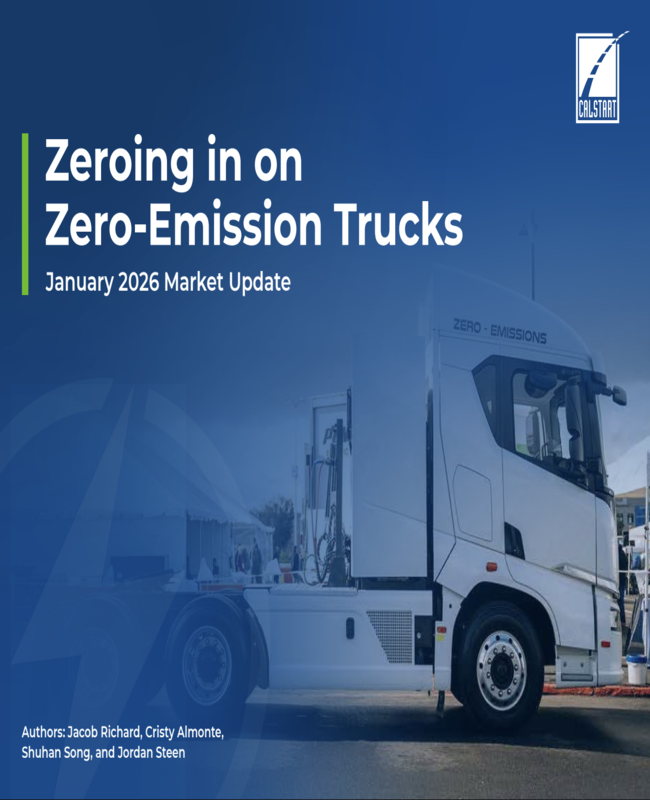
Zeroing in on Zero-Emission Trucks: January 2026 Edition

2026-01-29T12:35:55-05:00

The U.S. zero-emission truck (ZET) market continues to evolve, with this update capturing deployment activity — including purchases and leased vehicles — for cargo vans, medium-duty (MD) step vans, MD trucks, heavy-duty (HD) trucks, refuse trucks, and yard tractors as of June 2025.

Zeroing in on Zero-Emission Trucks: January 2026 Edition2026-01-29T12:35:55-05:00

Charging Up America: The Growth of United States Electric Vehicle Charging Infrastructure Jobs

2024-05-21T13:39:38-04:00

This paper projects the number of jobs that will be needed to expand electric light-duty vehicle (LDV) and medium- and heavy-duty vehicle (MHDV) charging infrastructure to meet annual charging needs through 2032. It quantifies the charging needs of a growing electric vehicle fleet that is aligned with newly proposed federal standards, and then projects the number of new jobs needed to deploy the necessary infrastructure.

Charging Up America: The Growth of United States Electric Vehicle Charging Infrastructure Jobs2024-05-21T13:39:38-04:00

Measuring Gaps in Supply and Demand for EV Battery Materials in the United States

2023-12-07T12:44:13-05:00

RMI’s paper, Measuring Gaps in Supply and Demand for EV Battery Materials in the United States, helps shed light on the state of today’s EVB supply chain and can inform investment and policy decisions; it can also clarify how much of the battery supply is expected to qualify for IRA incentives in the future by presenting a methodology for quantifying the gap between supply and demand of inputs and subcomponents along all major stages of the EVB supply chain.

Measuring Gaps in Supply and Demand for EV Battery Materials in the United States2023-12-07T12:44:13-05:00

Building the 2030 National Charging Network

2023-07-17T15:47:50-04:00

Plans for the national EV charging network will be shaped by a seminal study from the National Renewable Energy Laboratory (NREL), which has been at the forefront of assessing EV charging needs and developing state-of-the-art analytical tools for over a decade. In this study, researchers estimated the number, type, and location of chargers needed to create a comprehensive network of EV charging infrastructure, one that can support an anticipated 30–42 million EVs on the road by 2030.

Building the 2030 National Charging Network2023-07-17T15:47:50-04:00

The 2030 National Charging Network: Estimating U.S. Light-Duty Demand for Electric Vehicle Charging Infrastructure

2023-07-06T12:12:20-04:00

As established by the Infrastructure Investment and Jobs Act, also known as the Bipartisan Infrastructure Law, the Joint Office of Energy and Transportation (Joint Office) is setting the vision for a national charging network that is convenient, affordable, reliable, and equitable to enable a future where everyone can ride and drive electric. This report supports the vision of the Joint Office by presenting a quantitative needs assessment for a national charging network capable of supporting 30–42 million PEVs on the road by 2030.

The 2030 National Charging Network: Estimating U.S. Light-Duty Demand for Electric Vehicle Charging Infrastructure2023-07-06T12:12:20-04:00