Utilities and Electric Vehicles: Evolving to Unlock Grid Value
2018-12-11T16:04:59-05:00Report on how utilities can prepare for electric vehicle deployment.
Report on how utilities can prepare for electric vehicle deployment.
This report summarizes the results of a study using NREL's Electric Vehicle Infastructure Projection (EVI-Pro) model for the city of Columbus, Ohio.
This paper focuses on ride-sharing drivers – a topic to which little attention has been paid. In August 2015, Kelley Blue Book provided a dataset from its nationwide survey of U.S. residents aged 18 t...
This report presents approaches for electric vehicles as the future of mobility. They recommend three principles. 1. Take a multistakeholder and market-specific approach; 2. Prioritize high-use vehicl...
This resport explores how transportation network companies (TNCs) such as Uber and Lyft are impacting the use of public transit and personal automobiles....
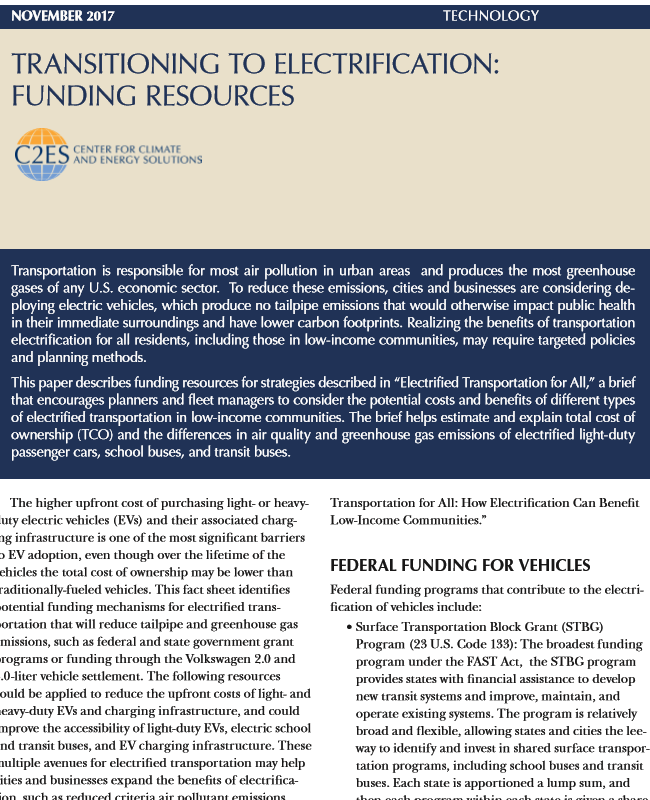
Transportation is responsible for most air pollution in urban areas and produces the most greenhouse gases of any U.S. economic sector. To reduce these emissions, cities and businesses are considering...
This paper describes funding resources for strategies described in “Electrified Transportation for All,” a brief that encourages planners and fleet managers to consider the potential costs and benefit...
This report provides an overview of the accelerating electrification of the transportation sector and explores the role of state utility regulators in evaluating potential investments by electric util...
In October 2015, EVCA published its inaugural "State of the Charge" report on California's EV charging industry. A lot of progress has been made in the two years between the first report and its recen...
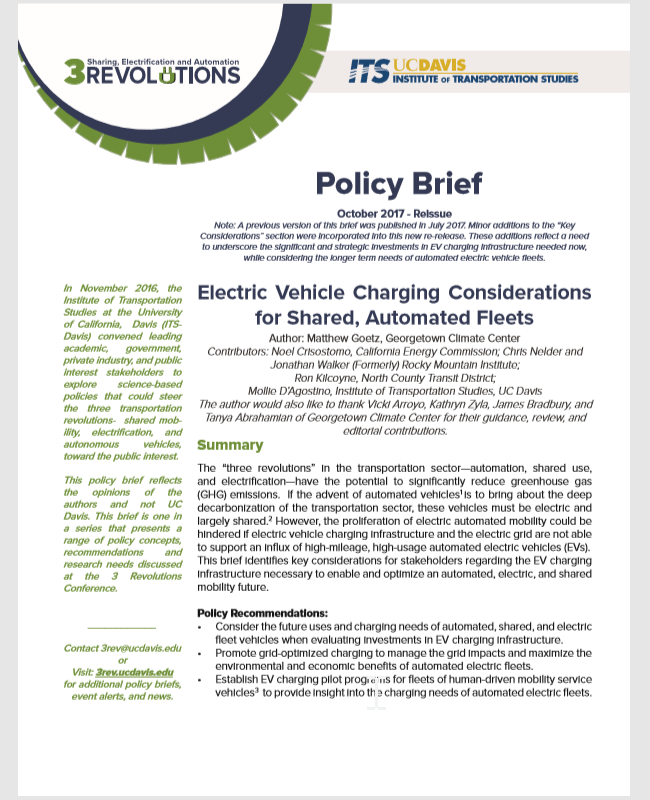
The “three revolutions” in the transportation sector—automation, shared use, and electrification—have the potential to significantly reduce greenhouse gas (GHG) emissions. If the advent of automated ...